Prayer

Abwoon d’bwashmaya (Our Father which art in heaven)
Father-Mother of the Universe. Source of All that Is,
Nethqadash shmakh (Hallowed be thy name)
May we within our inner shrines of prayer and meditation honour the sacred resonance of your Name.
Teytey malkuthakh (Thy kingdom come)
May we come to live in full awareness of your Presence.
Nehwey tzevyanach aykanna d’bwahmaya aph b’arha (Thy Will be done in earth, as it is in heaven)
May this realm of the physical become imbued with Consciousness and Light.
Hawvlan lachma d’sunqanan yaomana (Give us this day our daily bread)
May we receive that which we need so that Life and Light and Love persist and grow within us.
Wahboqlan khaubayn (wakhtahayn) aykanna daph khnan shbwoqan
l’khayyabayn (And forgive us our debts, as we forgive our debtors)
May we be released from the guilt and shame that we suffer for past misdeeds even as we release others from our condemnation of their misdeeds.
Wela tahlan l’nesyuna
Ela patzan min bisha (And lead us not into temptation, but deliver us from evil)
May we be led from worlds of delusion, darkness and despair to the paths of life and light and love.
Metol dilakhie malkutha wahayla wateshbukhta l’ahlam almin.
Ameyn. (For Thine is the kingdom, and the power, and the glory, for ever. Amen.)
Ground of our Being. The Particular and All. The Beginning, Middle and End. Sacred, Sacred, Sacred.
Amen. Amen. Amen.
I found this meditation on the Lord’s Prayer here. It is from Prayers of the Cosmos: Meditations on the Aramaic Words of Jesus by Neil Douglas-Klotz.
I was inspired to do my own meditation/variant on the words:
Father-Mother of the Universe. Source of All that Is,
May we within our inner shrines of prayer and meditation honour the sacred resonance of your Name.
May we come to live in full awareness of your Presence.
May this realm of the physical become imbued with Consciousness and Light.
May we receive that which we need so that Life and Light and Love persist and grow within us.
May we be released from the guilt and shame and fear we suffer for past misdeeds even as we release our condemnation of others.
May we be led from worlds of delusion, darkness and despair to the paths of life and light and love.
Ground of our Being. The Particular and All. The Beginning, Middle and End. Sacred, Sacred, Sacred.
Amen. Amen. Amen.
Banning the Veil

I wrote the following in response to a couple of online articles, here and here, about banning the veil:
The burka and niqab change the nature of social interactions and are expressions of a philosophy or mindset that is antithetical to individual freedom and social cohesion. The face mask is anti human and anti community. It is not a part of Islam but is a cultural phenomenon that expresses values similar to thosethat drive female genital mutilation. Islam asks only for modesty and the hijab is an honourable and sufficient expression of devotion. Fully covering the face and body in public should be considered as unacceptable as fully uncovering the body and both of these extremes are ‘immodest’ if modesty is defined as a ‘disinclination to call attention to oneself’.
We either want a society based on a perception of shared humanity or we want one where identities such as race, gender, caste, religion, class, sexuality etc. take precedence over common identities as human beings and citizens and define who we are and how we relate as humans and as citizens.
One of the most touching comments I’ve heard about the veil and its banning was that of a French Muslim girl who said that her country had protected her when her family did not.
Mabon

The Autumn Equinox, “Mabon”, marks the middle of harvest, it is a time of equal day and equal night, and for the moment nature is in balance. It is a time to reap what you have sown, of giving thanks for the harvest and the bounty the Earth provides. For finishing up old projects and plans and planting the seeds for new enterprises or a change in lifestyle. Mabon is a time of celebration and balance.
This is the time to look back not just on the past year, but also your life, and to plan for the future. In the rhythm of the year, Mabon is a time of rest and celebration, after the hard work of gathering the crops. Warm autumn days are followed by chill nights, as the Old Sun God returns to the embrace of the Goddess.
The passing of Mabon is inevitable and The Sun God should be mourned. We too, must remember that all things must come to an end. So the Sun God journeys into the lands of winter and into the Goddess’ loving arms, but endings are a good time to celebrate our successes, thank our selves and those who helped us, and take part in the balance of life!
Source: www.thewhitegoddess.co.uk
Is Islam a Religion of Peace?
Kafir Girl is the blog and nom de plume of a very funny writer who offers a detailed and devastating critique of the Quran highlighting its absurdities and unpleasantness. Kafir Girl stopped writing in 2009 and there is no trace of her on the web but the blog remains and is a very useful resource.
I remembered KG’s blog when I saw this video of Mosab Hassan Yousef, the son of a Hamas leader:
Mosab condemns Islam as a religion/philosophy but does not condemn Muslims who he rightly says are on the whole good people. This is an important distinction. Most Muslims seem oblivious to the pernicious nature of the Quran. All religious scriptures have deeply offensive bits but they also have elevated and elevating passages. I have yet to find anything elevating in the Quran though I was impressed by the ‘anti-racist’ statement in Mohammed’s last sermon:
All mankind is from Adam and Eve, an Arab has no superiority over a non-Arab nor a non-Arab has any superiority over an Arab; also a white has no superiority over a black nor a black has any superiority over white except by piety and good action. Learn that every Muslim is a brother to every Muslim and that the Muslims constitute one brotherhood. Nothing shall be legitimate to a Muslim which belongs to a fellow Muslim unless it was given freely and willingly. Do not, therefore, do injustice to yourselves.
I think that this does not appear explicitly in the Quran but is a hadith. Nevertheless credit where it’s due.
Mosab’s passionate honesty about his former faith reminds me of Gilad Atzmon an Israeli Jew who talks about ‘Jewish indoctrination’ much as Mosab talks about Islamic indoctrination.
Mosab’s views reminded me to online conversations I’ve had with young people on the NYPO Forum and also of a debate at the Oxford Union which asked whether Islam is a religion of peace. Here are two videos of speakers from opposing sides of the motion:
First Anne-Marie Walters:
and then the reply from Medhi Hassan:
Medhi’s defense is stellar and on the surface persuasive but it is persuasive about the wrong question. Medhi misses the point or evades it. He is defending Muslims rather than Islam and it is not Muslims who are the issue. Neither Mosab nor Anne-Marie is saying that Muslims are bad or worse than any other group; they are saying that the majority are decent people not because of Islam but despite it.
There is a need for adherents of every religion or other ideological system to be critical of their own religion or ideology.

I deeply respect people like Mosab and Atzmon who are prepared to challenge the orthodoxies that they are born into.
Ultimate Conspiracy
Despite its title, ‘The Gods of David Icke’, this video has nothing to do with David Icke. Rather it contends that what can broadly be described as the ‘New Age movement’ is part of an extensive ‘Luceferian’ conspiracy that links Aleister Crowley, HP Blavatsky, Teilhard de Chardin, Spiritualism, The Beatles, The Rolling Stones, Ecumenism, Darwinism, the United Nations, the New World Order, Nazism and much else. The premise is that dark spiritual forces have been enticing mankind to rebel against God since the original enticement in Eden.
The video does a nice job of connecting the dots to depict an ‘ultimate conspiracy’ that culminates with the extermination of billions of people and the coming of the ‘Antichrist’. While I do not endorse the underlying thesis I think that there are elements of truth here and the video was interesting enough to keep me watching for two and a half hours.
Epistemic Humbleness
In my post Essence, I wrote:
To the three figures of the Buddha, the Christ and the Prophet, I should add a fourth, the Philosopher/Scientist whose key truth is [epistemic] Humbleness, and whose posture and practice is that of Study. Socrates said that “The only thing I know is that I know nothing†while Newton said “I do not know what I may appear to the world, but to myself I seem to have been only a boy playing on the sea-shore, and diverting myself in now and then finding a smoother pebble or a prettier shell than ordinary, whilst the great ocean of truth lay all undiscovered before me.â€
I thought that maybe I should say that the key insight or quality of the philosopher/scientist is Rationality but somehow ‘epistemic humbleness’ seems to fit better. Isaac Newton also wrote:
“If I have seen further than others, it is by standing upon the shoulders of giants.â€
This expresses the humility that is essential to the scientific project. It presents science as a collective enterprise that can be advanced by those of normal stature as well as giants like Newton.
Pantheism
This Facebook post prompted some thoughts on my own religious orientation:
Is pantheism really all that different from atheism?, it seems to me all the pantheist is really doing is to say that the universe is “God”, but as far as I can tell, this doesn’t mean the pantheist believes the universe is a person, or anything of the sort.
Pantheism is the only logically consistent way in which God can be omniscient and omnipresent. If you are present everywhere and aware of everything you are necessarily everything. Pantheism differs from Atheism insofar as Pantheists understand that consciousness is as fundamental to constitution of the universe as matter, energy, space and time. Universal Consciousness cannot be said to be personal without contradiction but that does not mean that we cannot have a personal relationship with It or that it is not responsive to us. Hinduism, Buddhism and Taoism are essentially pantheist believing essentially in transcendent and immanent divinity (Brahman and Atman in Hinduism). Christian and Islamic mysticism are also affectively pantheist.
There were some other interesting responses among these was a link to a classic Asimov short story:
I haven’t listened to all of this yet – though I read it decades ago.
Also someone posted a link to an interesting blog Ownerless Mind.
Not Peace But a Sword
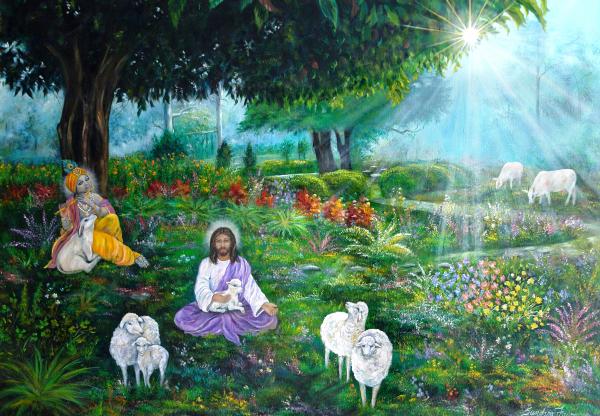
This passage from Matthew 10:34-39 (New International Version) is often misunderstood:
34 “Do not suppose that I have come to bring peace to the earth. I did not come to bring peace, but a sword. 35 For I have come to turn
“‘a man against his father,
a daughter against her mother,
a daughter-in-law against her mother-in-law—
36 a man’s enemies will be the members of his own household.’[a]37 “Anyone who loves their father or mother more than me is not worthy of me; anyone who loves their son or daughter more than me is not worthy of me. 38 Whoever does not take up their cross and follow me is not worthy of me. 39 Whoever finds their life will lose it, and whoever loses their life for my sake will find it.
The passage is often quoted to suggest that Jesus is not peaceful. It has been used to portray Jesus as a cult leader turning disciples against their families. In the context of the teaching of Jesus as a whole, this interpretation is not valid. When Jesus says “Anyone who loves their father or mother more than me is not worthy of me”, he is talking about the Spirit within him and within all of us, about the Path. Jesus is acknowledging the truth that following a spiritual Path takes you outside the circle of family, tribe, culture. We have a choice between sticking with the social norm or being true to ourselves.
To be true to ourselves is to come into conflict with others who would be happier if we did not challenge the social or familial norm. By following our own path we become unfamiliar.
It may happen that you disagree with a war that your country is waging, that you have a relationship not approved of by your tribe. You are standing for personal honour rather than family honour for your truth rather than society’s. If we are true to ourselves we are necessarily outsiders whether we are in a crowd or alone because the crowd does not matter.
Jesus is for peace, he says “blessed are the peacemakers, for they will be called children of God”, but he knows that there is no true peace where there is no justice, honour, love and freedom.
It is difficult to stand for values that stand against the values of our family and culture. This dilemma is addressed in the Bhagavad Gita where the warrior Arjuna expresses dismay to Krishna at being called to arms against family members:
[Arjuna] spoke these words to Lord Krishna: O Lord, (please) stop my chariot between the two armies until I behold those who stand here eager for battle and with whom I must engage in this act of war. (1.21-22)
I wish to see those who are willing to serve the evil-minded son of Dhritaraashtra by assembling here to fight the battle. (1.23)
Sanjaya said: O King, Lord Krishna, as requested by Arjuna, placed the best of all the chariots in the midst of the two armies; (1.24)
Facing Bheeshma, Drona, and all other Kings; and said to Arjuna: Behold these assembled Kurus! (1.25)
There Arjuna saw his uncles, grandfathers, teachers, maternal uncles, brothers, sons, grandsons, and comrades. (1.26)
Seeing fathers-in-law, all those kinsmen, and other dear ones standing in the ranks of the two armies, (1.27)
Arjuna was overcome with great compassion and sorrowfully said: O Krishna, seeing my kinsmen standing with a desire to fight, (1.28)
My limbs fail and my mouth becomes dry. My body quivers and my hairs stand on end. (1.29)
The bow, Gaandeeva, slips from my hand and my skin intensely burns. My head turns, I am unable to stand steady and, O Krishna, I see bad omens. I see no use of killing my kinsmen in battle. (1.30-31)
I desire neither victory nor pleasure nor kingdom, O Krishna. What is the use of the kingdom, or enjoyment, or even life, O Krishna? (1.32)
Because all those, for whom we desire kingdom, enjoyments, and pleasures, are standing here for the battle, giving up their lives and wealth. (1.33)
Teachers, uncles, sons, grandfathers, maternal uncles, fathers-in-law, grandsons, brothers-in-law, and other relatives. (1.34)
I do not wish to kill them, who are also about to kill, even for the sovereignty of the three worlds, let alone for this earthly kingdom, O Krishna. (1.35)
O Lord Krishna, what pleasure shall we find in killing the sons of Dhritaraashtra? Upon killing these felons we shall incur sin only. (1.36)
Therefore, we should not kill our brothers, the sons of Dhritaraashtra. How can we be happy after killing our kinsmen, O Krishna? (1.37)
Though they, blinded by greed, do not see evil in the destruction of the family, or sin in being treacherous to friends. (1.38)
Why shouldn’t we, who clearly see evil in the destruction of the family, think about turning away from this sin, O Krishna? (1.39)
With the destruction of the family, the eternal family traditions are destroyed, and immorality prevails due to the destruction of family traditions. (1.40)
And when immorality prevails, O Krishna, the women of the family become corrupted; when women are corrupted, social problems arise. (1.41)
This brings the family and the slayers of the family to hell, because the spirits of their ancestors are degraded when deprived of ceremonial offerings of rice-ball and water. (1.42)
The everlasting qualities of Varna and family traditions of those who destroy their family are ruined by the sinful act of illegitimacy. (1.43) (Note: Varna means color, or the make up and the hue of mind; a social division or order of society such as caste in India.)
We have been told, O Krishna, that people whose family traditions are destroyed necessarily dwell in hell for a long time. (1.44)
Alas! We are ready to commit a great sin by striving to slay our kinsmen because of greed for the pleasures of the kingdom. (1.45)
It would be far better for me if the sons of Dhritaraashtra should kill me with their weapons in battle while I am unarmed and unresisting. (1.46)
Sanjaya said: Having said this in the battle field and casting aside his bow and arrow, Arjuna sat down on the seat of the chariot with his mind overwhelmed with sorrow. (1.47)
Source: Exploring Ancient World Cultures
Arjuna says “My limbs fail and my mouth becomes dry. My body quivers and my hairs stand on end. The bow, Gaandeeva, slips from my hand and my skin intensely burns. My head turns, I am unable to stand steady and, O Krishna, I see bad omens. I see no use of killing my kinsmen in battle.” We know exactly how that feels, any conflict raises feelings of apprehension and regret, and all the more when that conflict with those who are close to us.
Krisha’s answer to Arjuna is essentially that the world is transitory and our gaze should be fixed on the spiritual unmanifest world. Like Jesus, Krishna says seek the eternal first:
When your mind becomes fixed on Me, you shall overcome all difficulties by My grace. But, if you do not listen to Me due to ego, you shall perish. (18.58)
If due to ego you think: I shall not fight; this resolve of yours is vain. Your own nature will compel you (to fight). (18.59)
What you do not wish to do out of delusion; you shall do even that against your will, bound by your own nature-born Karma, O Arjuna. (18.60)
The Lord abides in the heart of all beings, O Arjuna, causing all beings to act (or work out their Karma) by His power of Maya as if they are (puppets of Karma) mounted on a machine. (18.61)
Seek refuge in Him alone with all your heart, O Arjuna. By His grace you shall attain supreme peace and the eternal abode. (18.62)
Thus the knowledge that is more secret than the secret has been explained to you by Me. After fully reflecting on this, do as you wish. (18.63)
Hear again My supreme word, the most secret of all. You are very dear to Me, therefore, I shall tell this for your benefit. (18.64)
Fix your mind on Me, be devoted to Me, offer service to Me, bow down to Me, and you shall certainly reach Me. I promise you because you are very dear to Me. (18.65)
Setting aside all noble deeds, just surrender completely to the will of God (with firm faith and loving contemplation). I shall liberate you from all sins (or bonds of Karma). Do not grieve. (18.66)
This (knowledge) should never be spoken by you to one who is devoid of austerity, who is without devotion, who does not desire to listen, or who speaks ill of Me. (18.67)
Krisha and Jesus (Christ) are both speaking as God, as representatives of our own inward and transcendent reality. Because they have attained a particular enlightenment and self-transcendence they can speak in this way. They have the same understanding and authority. Jesus is the Son of God and so is Krishna and so are all of us when we transcend the personal.
When Jesus talks about bringing a sword he is talking about the requirement for total commitment. This is a recurring theme in his teaching, as Krishna says “surrender completely to the will of God” so Jesus says “give up all you have and follow me” (Mark 10:21) and compares attaining the ‘Kingdom of Heaven’ (enlightenment) to a merchant wanting to buy the finest pearl and selling all he has to obtain it.’
The bottom line for Jesus, Krishna and the Buddha and all enlightened teachers is that half measures are not acceptable. We may compromise because we are human, and we will be forgiven, time and again, but the truth does not compromise. We may deviate from the Path and return but when we are off the Path we are lost in illusion whether that illusion is pleasurable or painful.
“No man can serve two masters” says Jesus (Matthew 6:24) “for either he will hate the one, and love the other; or else he will hold to the one, and despise the other. You cannot serve God and mammon.”
For Jesus and Krishna the sword and the war are metaphors for the struggle to be true to our Inner Light, our Dharma, God, whatever we choose to call it. In order to be true to God and ourselves we come into conflict with the world, with friends, family and most importantly with our own habits and desires, in short with the familiar and the comfortable.
This above all; to thine own self be true, and it must follow, as the night the day, thou canst not then be false to any man. Shakespeare.
It is only in facing the conflict, inner and outer, that we become warriors of spirit and are able to gain enlightnment of the Kingdom of Heaven.
Loy Khatong and Yi Peng

This lovely image of lights floating into the sky is associated with the coinciding Loy Khatong and Yi Peng festivals in Thailand. The festivals take place on the Full Moon of the 12th month of the Thai calendar (28th November this year). Loy Khatong involves building a small raft for a candle and floating it down the river, Yi Peng involves releasing into the sky a rice paper lantern filled with air heated by a candle or fuel cell.
According to Wikipedia:
.. the act of floating away the candle raft is symbolic of letting go of all one’s grudges, anger and defilements, so that one can start life afresh on a better foot.
This sounds worth celebrating …